
Tony's Story: The Tallest Wall in the World
In her recent post, Amy wrote about a young cashier in northeast Brazil holding a container of blueberries, wondering if they tasted like grapes.
That question was never really about fruit. It was about access.
It was about the quiet, heavy line between the world you are standing in and a world you can see right in front of you but cannot reach.
Reading her words brought me right back to my own beginning.
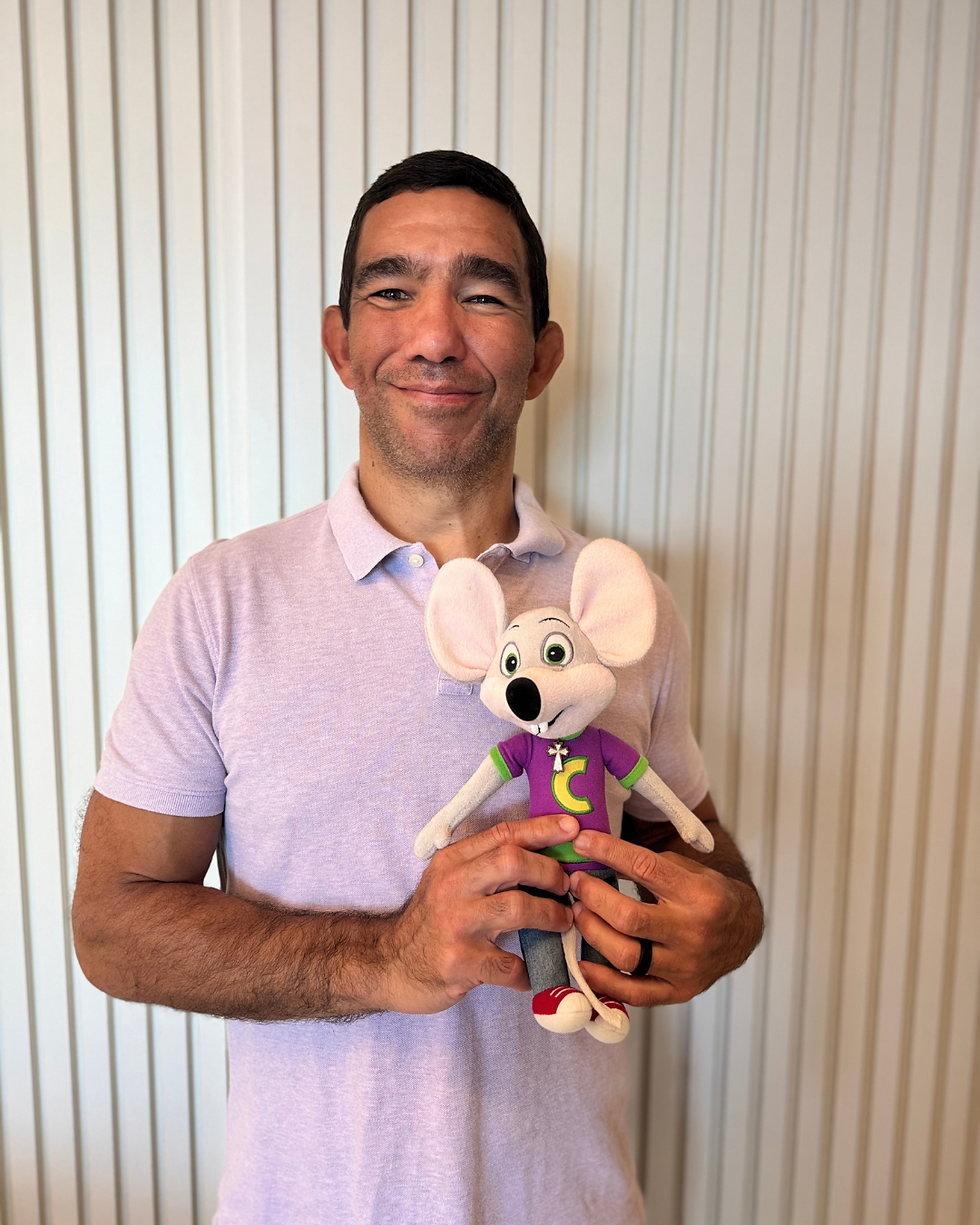
When I immigrated from Brazil to the United States in my early twenties, my first years were defined by a very specific kind of grind. I worked in landscaping for a few months, and later I took a job as the mouse mascot at Chuck E. Cheese. I worked twelve-hour shifts in that heavy suit, returned home to a dark room, and lay in bed with the sounds of arcade games still ringing in my mind. I rode my bicycle to work year-round, even in the snow.
To make sure I had enough to eat, I learned a survival trick. I would secretly take two leftover slices of pizza at the end of the kids’ party or the end of the day that was left on the tables when clients went home, press them together cheese-side in, slide them into my pockets, and slip into a bathroom stall to eat them quickly where no one could see. My other favorite snack/meal at the time was peanut butter sandwich crackers. Nostalgia, even today!
Those years meant being far from family and my support network, navigating a new language and culture, and constantly experiencing being misunderstood or negatively judged. That kind of isolation has a way of breaking you down, if you let it. But it also builds a deep, unshakeable fortitude, alongside genuine empathy for others.
On my days off, I used to walk around Reston Town Center, a beautiful planned community in Northern Virginia filled with nice shops and open-air restaurants. I remember standing outside one restaurant, staring at a small, knee-high planter filled with flowers that marked the patio perimeter.
To the people sitting at those tables, that low barrier was just a piece of landscaping. To me, standing on the outside, it felt like the tallest wall in the world.

I would look at the people eating inside and wonder what it would take to surmount that wall; to sit at those tables and afford that food. There was an intense longing and curiosity, but never shame. I took pride in my work. Even when cleaning dirty bathrooms or hosting birthday parties for minimum wage without tips, I felt joy, dignity, and deep gratitude to be in a country built on opportunity shaped by generations whose hard work and generosity has paved the way.
Before I could ever cross that physical barrier, I had to take a huge leap of faith and risk what felt like everything. With limited English and few connections, I decided to leave behind a steady paycheck, however humble, to pursue teaching Jiu-Jitsu full-time. It was terrifying and uncertain.
One of my mentors gave me the perspective I needed to make the move with words that still echo in my mind: "The rat will still be there." He meant that if Jiu-Jitsu failed, the Chuck E. Cheese suit would be waiting and I could always go back. So I took the leap.
The path was anything but smooth. Early on, I was taken advantage of by academy owners who withheld pay, overworked me, and took credit for my efforts. Later, a dear friend opened an academy with me, only for another venture of his to go bankrupt, forcing the school to close.
Yet necessity breeds innovation. With nothing left to lose, and with the encouragement from my wife Amy who was in business school at the time, together we stepped out again and opened our own academy, Team Passos Jiu Jitsu.

Fast forward two decades: I have been able to build a successful business, bought a house, and created a life I once only viewed from the other side of that low wall. Thousands of students from across the globe have walked through our doors, not just learning Jiu-Jitsu, getting in shape, and building self-confidence, but experiencing personal transformations that have overflowed into restored marriages, career shifts, and healthier organizational cultures.
We built a team at our headquarters in Sterling, Virginia, raised up coaches who are now developing the next generation of leaders, built an international affiliation network, coached world-class professional athletes on the global stage, and through our training and consulting we’ve helped other academy and business owners build thriving businesses and live the lives of their dreams.
Co-founding DreamRoot allowed us to extend this work back to my hometown in Brazil and into communities around the world, helping others gain the vision, skills, and connections needed to cross their own divides.
None of this is about building an impressive resume or collecting achievements. Those are just outcomes. What changed my trajectory were the inputs and committing to the process: mindset, skills, relationships, opportunity, and the people willing to walk alongside me.
Looking back today, I am profoundly grateful for every step. Who could ever have imagined all of this was possible on the day I quit my job at Chuck E. Cheese?
That choice was a pivotal moment, but it was not the only defining one. What we practice daily builds the capacity to achieve and then multiply a vision. It was marked by the day I stepped onto the airplane from Brazil to the U.S. It started with my family sacrificing endlessly in Brazil to raise me with core values. It continued every after leaving Chuck E. Cheese, especially the hard day, choosing to show up, do the unglamorous work, and keep going. After all, we could always go back to where we started and stay there.
There are no words to express the profound joy and fulfillment of seeing the fruits of what a simple "yes" can do. It is a testimony to the power of persistence; of drilling foundational moves over and over until competence takes root, building new skills on top of that base, and inviting others. It required stepping out of the comfortable safety of the known and believing a different future was possible.
It all required a willingness to step out of the comfortable safety of the known. It demanded the courage to value myself enough to believe that a different future was possible, if not just for me, then for everyone depending on me.
The question remaining today is: what are we going to say yes to right now? How will we continue moving forward exponentially, building upon all of this to reach far beyond our wildest dreams? We press forward, not just for ourselves, but for everyone around us.
Over years of working with leaders, entrepreneurs, and accomplished professionals, a pattern has emerged. Each facing a wall, even those inside that restaurant, confronting their own barriers, blind spots, and uncharted territory.

When Amy wrote about vision, she hit on a central truth: you cannot become what you cannot first see. But vision alone is not enough. I could never have crossed that wall by myself. It took people who opened doors, stood in my corner, and modeled what was possible. Friends, mentors, and students alike did not just show me a new room; they taught me how to navigate it. They invested time, made introductions, taught me things I did not know I needed to know, and gave me space to practice, fail, learn, and try again.
That brings us back to the heart of what we do through DreamRoot, Team Passos and everything we are building. Our task is to create conditions where people can step into their full potential through connection, learning, solidarity, and shared opportunity, starting with ourselves.
How do we level those invisible, seemingly impossibly high walls?
It is not a handout.
It is about restoring full human dignity, recognizing people not merely as recipients, but as co-contributors, co-dreamers, and co-developers. We become more fully ourselves through relationships and contribution.
Bridging the gap can be practical and simple: Shifting vision by seeing a different model, building a skill, sending an invite, making an introduction, giving someone a chance, or investing the time. If we do, we just might be surprised beyond our wildest imaginations.
Whether it is a cashier holding a blueberry or a young immigrant looking over a restaurant’s half-wall planter, the desire to dream is already there. Our job is not to carry people over the finish line. Our job is to build the bridges, fan the embers, to make sure no one is left standing on the outside with no way over.
Sometimes the wall is not as high as it looks. Sometimes what is needed is simply someone willing to stand beside you and help you see the way over.
Our task is to create conditions where people can step into their full potential through connection, learning, solidarity, and shared opportunity, starting with ourselves.



Comments