
Rethinking Competition in Business: Lessons from Cheese Sellers on the Beach in Brazil
Updated: Sep 22

What if competition in business wasn't about under-cutting your rivals, but about mutual assistance?
It may sound like an oxymoron. I know. But hear me out.
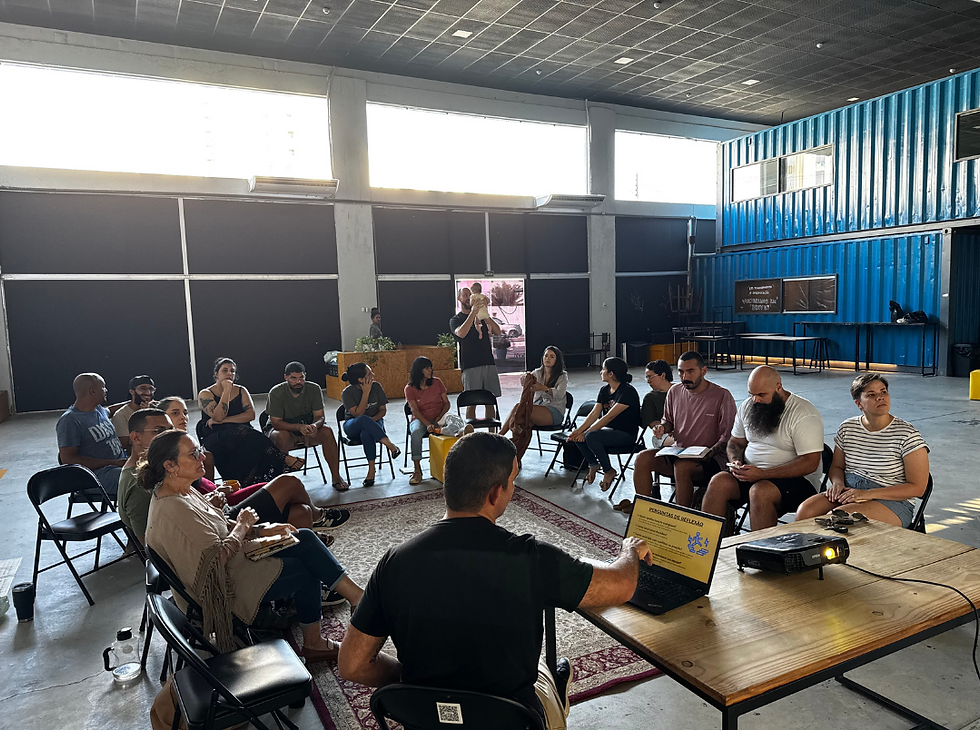
During a recent redemptive business training we facilitated in Recife, Brazil, this was one of the core concepts we explored.
To show you what this looks like in practice, let me share an experience we recently witnessed on the beach in Brazil.
Grilled Cheese on the Beach
While sitting at the beach one weekend, we saw two men near the shoreline. One was holding a cooler in one hand and a tiny makeshift grill in the other. The second man was pushing a three-wheeled cart through deep sand in 85-degree heat under the equatorial sun. Inside the cart was also a cooler and a built-in charcoal grill.
They sell queijo coalho, a delicious white cheese from the Northeast region, served plain or topped with oregano or honey. It’s a true highlight of beach trips - as those who have joined us on DreamRoot’s Brazil Exchange Trip can attest.

Because the sellers are constantly walking up and down the shoreline, there isn't one fixed spot where you can expect them to be. You just have to wait for the right timing.
The anticipation is part of the thrill. When they finally arrive, the joy goes both ways. For the buyer, it’s the excitement of fresh grilled cheese. For the seller, every sale is a lifeline because they are living at the poverty line. It means food on the table for that day.
Technically, these two men are direct competitors. On the surface, if one sells, the other doesn't.
Yet, they found a way to support each other.
A Different Kind of Interaction
We watched as one seller came late to the beach. The first man greeted him with genuine care: "Hey, how are you? You’re late today, is everything okay?" They knew each other; they were used to seeing each other pass by on the selling route.
The second man replied, "Yeah, it’s been a hard morning. My distributor didn't get enough cheese to sell."
Without hesitating, the first man said, "Man, don’t worry about it. Let me give you some of my cheese so you can sell today, keep the profit, and just pay me back later." He made sure his fellow vendor could pay his bills and that he and his family could eat that day.
Then, the generous seller tried to roll his heavy cart away, but he had a flat tire, since extra profits for repairs are often slim. Seeing this, the man who had just received the cheese stopped what he was doing and helped push the heavy cart to a different section of the beach, ensuring both of them could start selling in fresh "markets" without doubling up on each other.
They don’t see themselves as competitors in the hyper-aggressive and undercutting sense we so often associate with business today. Instead, they see themselves first in community and connection with one another.
Their mindset is simple: Today I have, but you do not. Tomorrow, I may not have, but you might. So they share out of their overflow to get through days marked by intense physical, mental and emotional struggle, yet also sun-kissed with friendship, dignity, and respect.
The Reality Behind Every Sale
To put this into perspective, a skewer of queijo coalho costs around R$10.00 Reais (less than $2.00 USD). Most vendors sell on behalf of a middleman distributor, earning about 70% per sale, while still being responsible for their own material cost like charcoal. They need to sell a large volume of cheese just to make minimum wage, and even then, they remain in deep financial vulnerability.

Sales fluctuate wildly. Take-home income can range from R$21 Reais on a slow day to over R$7000 Reais on peak weekends and holidays. But if it rains, a regular occurrence in the winter season, no one goes to the beach, and they make zero.
Because most of these street vendors operate in the informal sector, they have no standard safety net: no unemployment insurance if they get injured, no retirement contributions, limited access to formal financing when times are tough, and few institutional protections. This makes growing or optimizing a business for productivity an uphill battle. Put simply, they are exposed to constant risk.
In order for their work to survive under these conditions, they rely heavily on social capital: the deep, trust-based relationships with suppliers, fellow vendors, and customers that enable their businesses to function day to day.
They are in survival mode. We’ve seen too often how the grueling physical labor and financial unpredictability drain the energy required to dream, plan, or design a path out of the cycle.
Yet, despite living in an environment of extreme material scarcity, they do not operate from a scarcity mindset.
Amongst all of this, they are creating local markets and adding genuine value for beachgoers and a rich and interconnected culture along the coasts of Brazil. They are building a life for themselves, often on the margins of society. Many love what they do, finding immense pride and joy in the work of their own hands and in the quiet satisfaction of every piece sold.
Perhaps the value they bring is undersold.

Redefining Competition as Mutual Assistance
A purely competitive, zero-sum mindset assumes that my gain must be your loss. We see this mindset all the time, even among affluent executives and white-collar professionals. It leads to ruthless practices and contributes to giving capitalism a bad name.
These beach vendors prove that you can face daily material scarcity without letting scarcity consume your worldview.
When you share a relationship with your competitors (and your entire supply chain and stakeholders, for that matter), our understanding of competition transforms into mutual assistance. It goes beyond random acts of charity. It is a shared recognition that you are on the same journey together. Before they are entrepreneurs and business owners, they are humans and neighbors.
And it makes good business sense. Having multiple vendors on the beach builds collective demand. It creates a vibrant culture that keeps beachgoers coming back for cheese rather than switching to alternatives. They keep the market alive together.
At its core, this comes down to our view of human nature. Are we merely isolated, selfish, utility-maximizing individuals? Or are we naturally relational beings desiring for and capable of connection, cooperation, and mutual flourishing? We carry the potential for both. Yet the latter being closer to our true nature.
When we view humans as purely selfish and stay disconnected, we build business, economic, and management systems of surveillance, control, and exploitation. We confuse people as the means and riches as the end, all of which trains people up and reinforces this distorted worldview and practice. But when we view business through a mutual assistance and relational lens, markets become a vehicle for people to exercise their talents, serve others, restore human dignity, and contribute to a collective potluck where everyone is better off. Our organizations and businesses become more collaborative, innovative, high-performing, leading to greater success across multiple bottom lines (including financial) both in the short and long term.
Widening the Table
Buying from vendors on the beach isn't a faceless, cold transaction; it’s a mutual exchange between real human beings. It reminds us that business and economics, no matter where you are, is never a "morally free zone." Every transaction reflects a choice about how we relate to one another and becomes part of a larger story about the kind of world we are helping to build.
We are far more interdependent than we often realize. None of us can flourish in isolation. We make up one body; the flourishing of the whole depends on the flourishing of its parts, and together we are more than the sum of our parts.
Markets exist because we need each other. They are an opportunity for us to contribute our talents to serve others.
What these Brazilian cheese sellers teach us is that value is created through relationships of trust, reciprocity, and mutual contribution. They did more than help one another to survive. They demonstrated that value is created through relationships of trust, reciprocity, and mutual contribution.
Together they are cultivating a healthier local market. By ensuring both vendors could continue selling, they are preserving customer choice, strengthening demand for their product, reinforcing trust, and sustaining an economic ecosystem that is benefiting everyone. They are not merely exchanging cheese for money; they are creating opportunities for others to flourish alongside them.
And they remind us that solidarity and mutual assistance create a social safety net that is remarkably resilient, even under the most difficult circumstances. All of this makes life so much more fulfilling and gratifying.
This is the heart of a redemptive vision for business. The ultimate purpose of enterprise is not to maximize profits or outperform competitors. In the language of civil economy, the goal is not simply to win the marketplace but to enlarge it. Not by extracting value from others, but by creating conditions where more people can participate in creating it.

Business is not a race to secure the biggest slice of the pie, but an ever-expanding banquet table where everyone is invited to contribute in shared flourishing. Redemptive businesses widen that table.
(This opens up the deeper topic of stewarding the common good, which I’ll save for a future post!)
Next time you look at a spreadsheet, launch a product, or evaluate your competitors, remember the cheese sellers on the beach. How might your business view your market not as a territory to capture, but as a community to serve? How might you widen the table so more people can co-create and flourish together?



Comments